

Hera begins studying the asteroid NASA crashed into, flying rectangles at the speed of a scurrying insect
Europe's Hera spacecraft is 25 to 30km from Didymos and Dimorphos, starting to find out whether DART's 2022 impact left a crater or reshaped the asteroid.
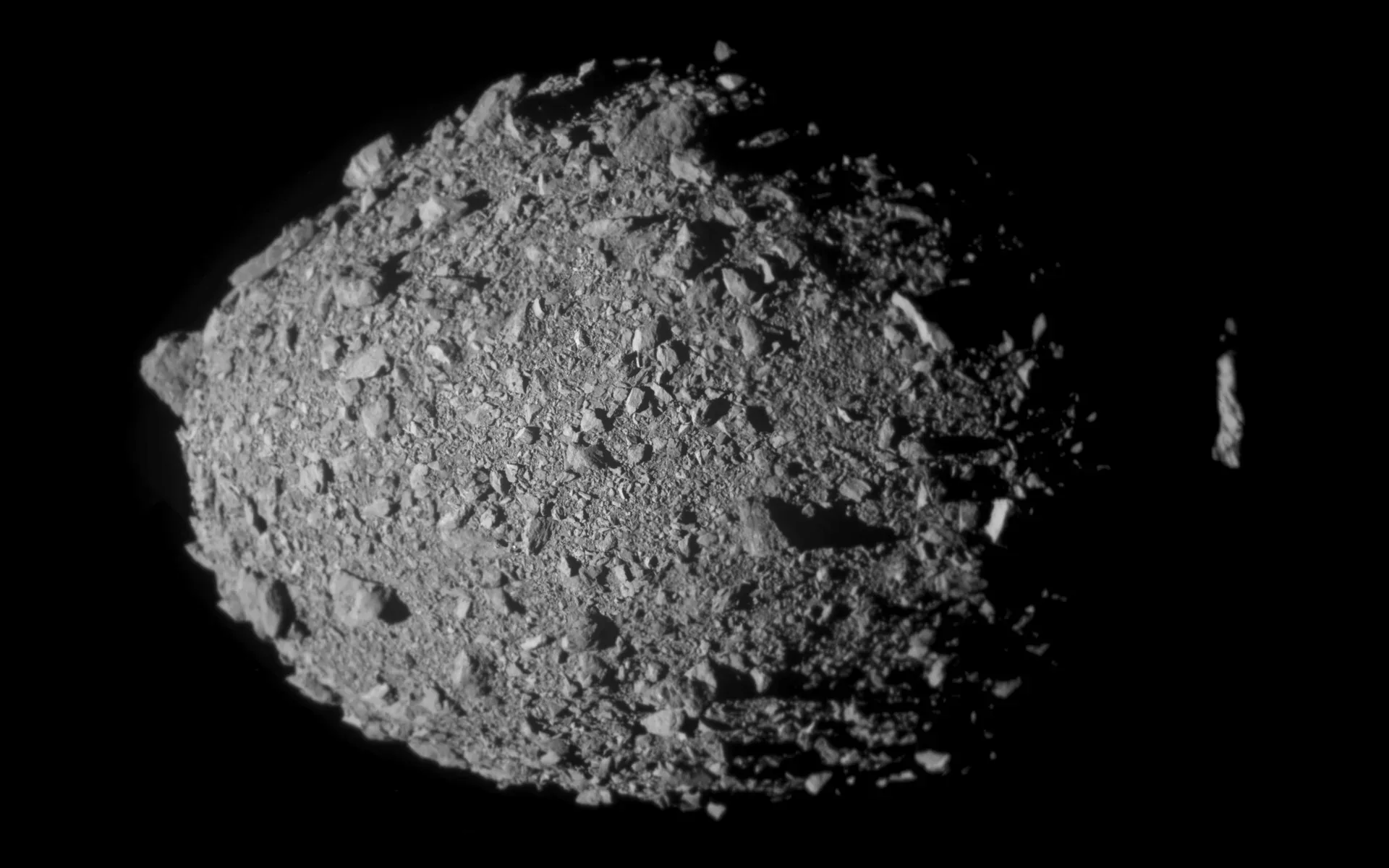
Europe's Hera spacecraft has begun its first science observations at the pair of asteroids NASA deliberately crashed into four years ago, and it is getting around them in an unusual way: by flying in rectangles, at about the speed of a scurrying insect.
The car-sized spacecraft is now travelling about 25 to 30 kilometres from the Didymos asteroid system, in what the European Space Agency calls its "early characterisation phase". Its job is to find out what really happened when NASA's DART spacecraft slammed into the smaller asteroid, Dimorphos, in September 2022, the first test of whether hitting an asteroid could change its path.
Why rectangles?
Didymos is about 780 metres across, with gravity around 40,000 times weaker than Earth's. Dimorphos is just 151 metres wide, with gravity around 200,000 times weaker. With pull that feeble, a normal circular orbit is not practical.
Instead, Hera moves around the pair's shared centre of gravity at about 12 centimetres a second, along nearly straight lines. Every three or four days, alternately, it fires its thrusters while heading away from the asteroids and turns by 90 degrees, tracing a series of "rectangular orbits".
The approach builds on ESA's experience with the Rosetta comet mission, and it is built to be safe: if a planned thruster firing fails, Hera drifts away from the asteroids rather than towards them. Moving so slowly, each correction uses very little fuel.
The scene of the crash
"Our aim right now is to gather the big-picture findings of relevance to supporting the mission's planetary defence goals," said mission scientist Michael Kueppers. "During this phase, our images will reveal for the first time what a small asteroid looks like globally, having experienced a hypervelocity impact in the context of the first asteroid deflection test."
"Previous predictions by our impact models suggested many different ways the asteroid body might react, but Hera will reveal which forecast was the correct one - if any!"
DART, a 580-kilogram spacecraft, hit Dimorphos at about 6.1 kilometres a second, throwing up a cloud of debris that spread across 10,000 kilometres. It worked: the time Dimorphos takes to orbit Didymos shortened by about 33 minutes, more than computer simulations had predicted. Hera should show whether the impact left a crater or reshaped the whole asteroid, and measure its make-up, structure and mass.
Closer next month
Next month Hera is due to start its "detailed characterisation phase", moving closer on bow tie-shaped paths that begin about 20 kilometres out. It will also release two shoebox-sized CubeSats to take measurements from even nearer, and the mission will eventually move on to landing operations.
Hera is flown from ESA's mission control in Darmstadt, Germany, about 196.5 million kilometres away, with contact for around eight hours a day through 35-metre dish antennas in Argentina, Spain and Australia.
Knowing exactly how an asteroid responds to being hit is what could turn this "kinetic impact" method into a dependable way to protect Earth, should a dangerous space rock ever be heading our way.
More in Science
All
Latest news
Featured posts
-
Things to do
Top 10 places to visit in Birmingham
-
Food and drink
The 12 most popular food spots in Birmingham
-
Things to do
The best laser tag locations in Birmingham