

Astronomers watch two stars merge into one in the Andromeda galaxy, a first caught by the Webb telescope
A Sun-like star spiralled into a supergiant nicknamed Big Bao. Webb observed it just 47 days after the eruption peaked, the earliest follow-up of its kind.
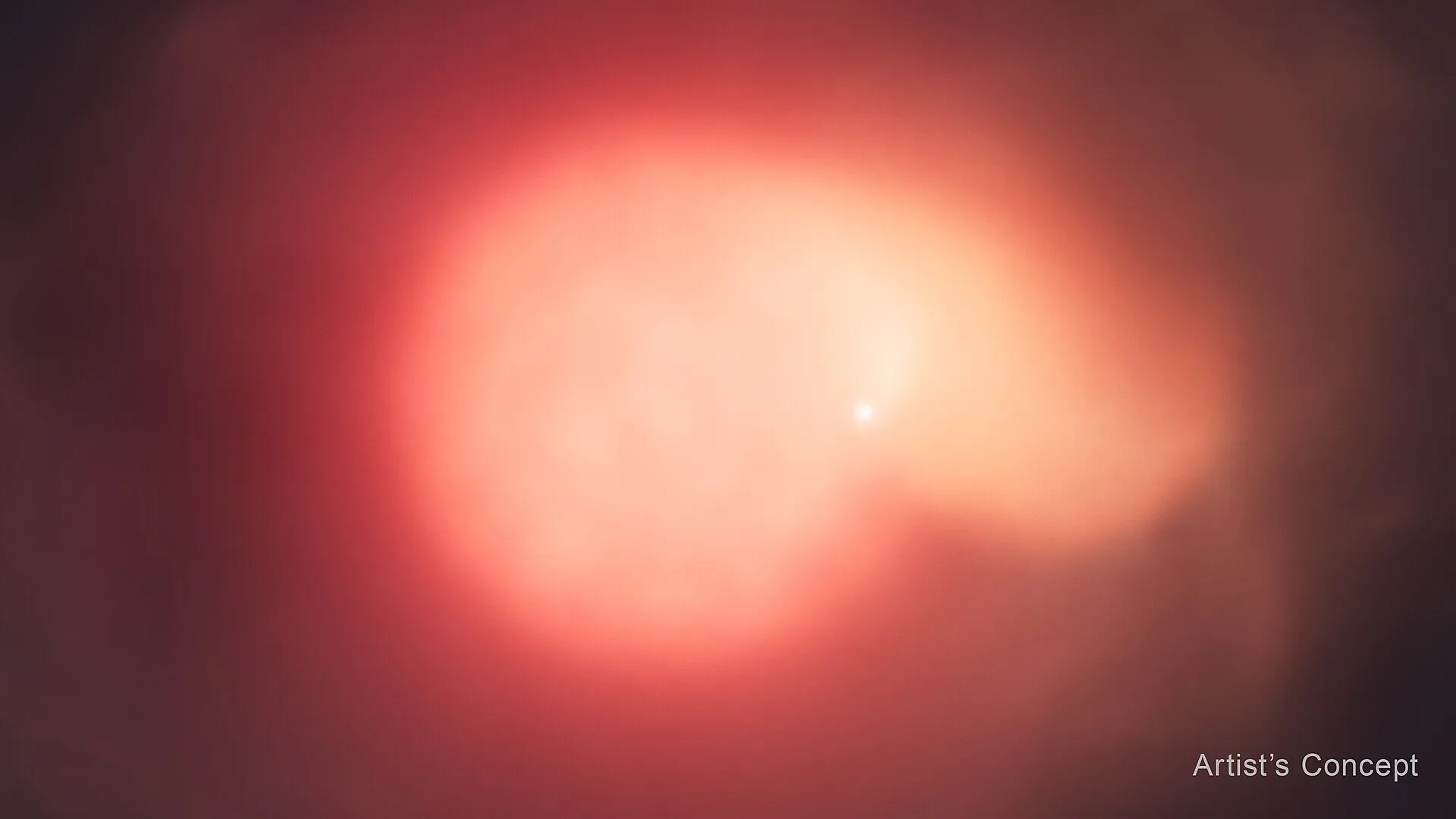
Astronomers have watched two stars in the neighbouring Andromeda galaxy merge into one, and pieced together what happened before, during and after, a first of its kind made possible by NASA's James Webb Space Telescope catching the aftermath just 47 days after the eruption peaked.
The system, nicknamed Bao and formally known as AT 2025abao, began as a pair: a puffy supergiant star and a companion slightly less massive than the Sun. The smaller star spiralled into its giant partner and was swallowed, leaving a single, possibly "rejuvenated" star. The findings were published in Nature on Wednesday, NASA said.
"Absolutely mind-blowing"
"Stellar mergers are very, very difficult to observe in real time because they are hard to predict," said Viraj Karambelkar, the paper's first author and a NASA Hubble Fellow at Columbia University in New York. "However, we noticed something unusual was going on in 2023 and continued to monitor the system to see what it would do. Then, in 2025, it erupted!"
"Webb observed Bao only 47 days after the stars' eruption peaked, the earliest ever follow-up of an event like this. The telescope's data helped us characterize what the system looked like before, during, and immediately after the merger, which is absolutely mind-blowing."
Big Bao and Little Bao
Modelling showed that before the eruption, the larger star was seven times as massive as the Sun, 350 times its radius and 18,000 times brighter, earning it the nickname "Big Bao". Its companion, "Little Bao", was about 0.7 times the Sun's mass.
"It was an absolute beast of a star, completely outshining its companion in the data," said co-author Karel Temmink, a PhD student at Radboud University in the Netherlands, who led the simulations.
Once the smaller star touched the giant's surface, the two merged after only about seven orbits, roughly seven years, far faster than other known mergers of smaller stars, which took thousands of orbits. As it orbited, the companion peeled gas off the giant's outer layers before plunging into its core, an encounter co-author Kishalay De of Columbia University described as "almost like a bomb exploding inside a living star".
Caught by a relay of telescopes
Bao first caught the team's eye in February 2023 in data from NASA's retired NEOWISE mission. Other telescopes then saw it brighten and throw off dust, before the Zwicky Transient Facility detected the eruption on 17 October 2025. Webb observed it on 24 December 2025.
Such events matter because pairs of stars that survive this stage can go on to become neutron stars and black holes, explode as supernovae or produce gravitational waves. Karambelkar expects many more to come as NASA's new Nancy Grace Roman Space Telescope begins its surveys. "There's going to be a large influx of similar discoveries just ahead," he said.
More in Science
All
Latest news
Featured posts
-
Things to do
Top 10 places to visit in Birmingham
-
Food and drink
The 12 most popular food spots in Birmingham
-
Things to do
The best laser tag locations in Birmingham