

The narwhal's 'unicorn horn' gets its strength from two spirals twisting in opposite directions
X-ray scans at three synchrotrons reveal the tusk is built like a rope, combining hardness with the flexibility it needs to swim.
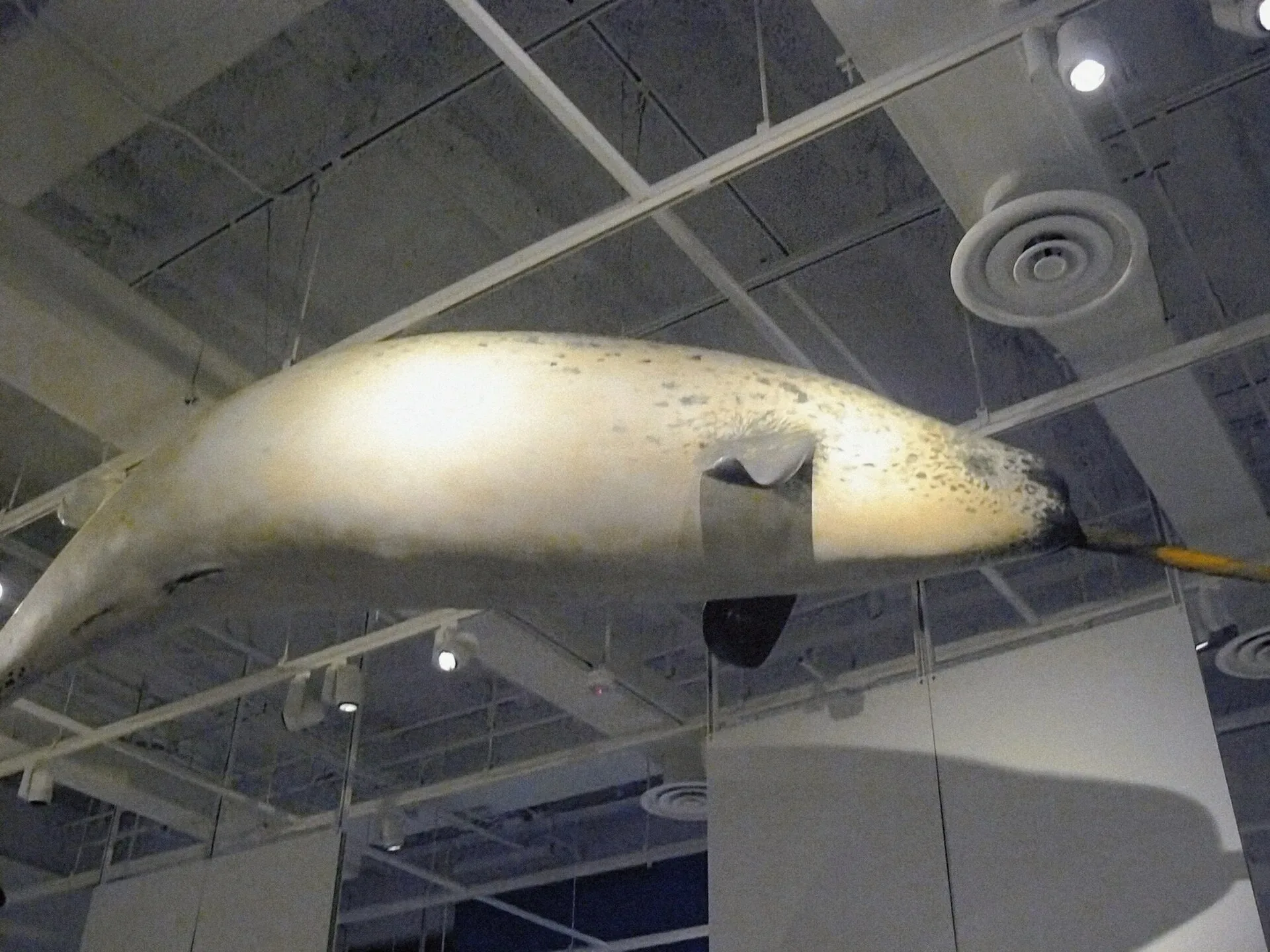
The narwhal's famous spiral tusk, once sold across Europe as a unicorn horn, owes its strength to two hidden spirals twisting in opposite directions, scientists have found.
Using advanced X-ray imaging at three European synchrotron facilities, an international team looked inside the tusk to see how its microscopic building blocks are arranged. The findings are published in Nature Communications.
A tooth, not a horn
The narwhal's tusk is not a horn at all, but a tooth. In males, usually the upper left canine grows forward through the upper lip, twisting anticlockwise as it extends. It can reach two metres long, as much as half the length of the animal's body, and keeps growing throughout the whale's life.
Its purpose is still not fully understood. Evidence suggests the tusks are mainly involved in choosing a mate, and narwhals have been seen crossing their tusks in playful "duels".
The tusk has a long history with people. In the 17th century, King Frederik III of Denmark sent an expedition to Greenland to find the source of the prized "unicorn horns", and the mission earned him a throne made from them.
Built like reinforced concrete
Most of the tusk is made of dentin, the same hard tissue found inside human teeth, covered by a thin layer of cementum. Both contain fine collagen fibres strengthened by tiny mineral crystals, rather like steel bars inside reinforced concrete.
"The narwhal tusk, too, must be both hard and flexible," said Marianne Liebi, a researcher at the Paul Scherrer Institute in Switzerland and co-author of the study. "Only then can it withstand the strong hydrodynamic forces that swimming generates."
"Connect the dots"
The team used a method called tensor tomography, rotating the tooth in an X-ray beam and combining millions of measurements into a three-dimensional picture. At first, they could not find the spiral they expected. "That puzzled us quite a bit," Liebi said. "But instead of a helix, all we saw was a regular pattern."
The breakthrough came when they looked at how each point was oriented relative to its neighbours. "All we had to do then was connect the dots - as in a children's paint-by-numbers kit - and suddenly the structure became visible: two intertwined spirals," said first author Adrian Rodriguez-Palomo, who began the work during his PhD at Chalmers University of Technology in Sweden and continued it at Aarhus University in Denmark.
Two spirals, one strong tooth
The outer cementum forms a left-handed spiral, while the collagen structures in the dentin beneath twist the opposite way. Together, the researchers say, they make an exceptionally stable structure, much like the twisted fibres of a rope, giving the tusk its strength, flexibility and resistance to stress.
The research was carried out at the Swiss Light Source at the Paul Scherrer Institute, the MAX IV Laboratory in Sweden and the European Synchrotron Radiation Facility in France. Beyond solving an old natural puzzle, nature's designs like this one are often studied by engineers looking for ideas for strong, lightweight materials.
More in Science
All


Latest news
Featured posts
-
Things to do
Top 10 places to visit in Birmingham
-
Food and drink
The 12 most popular food spots in Birmingham
-
Things to do
The best laser tag locations in Birmingham