

345-million-year-old 'Lizzie' fossil thought to be an early reptile turns out to have gills
X-ray scans of Westlothiana, found in Scotland, reveal a fish-like mouth with thousands of teeth, rewriting part of the story of life on land.
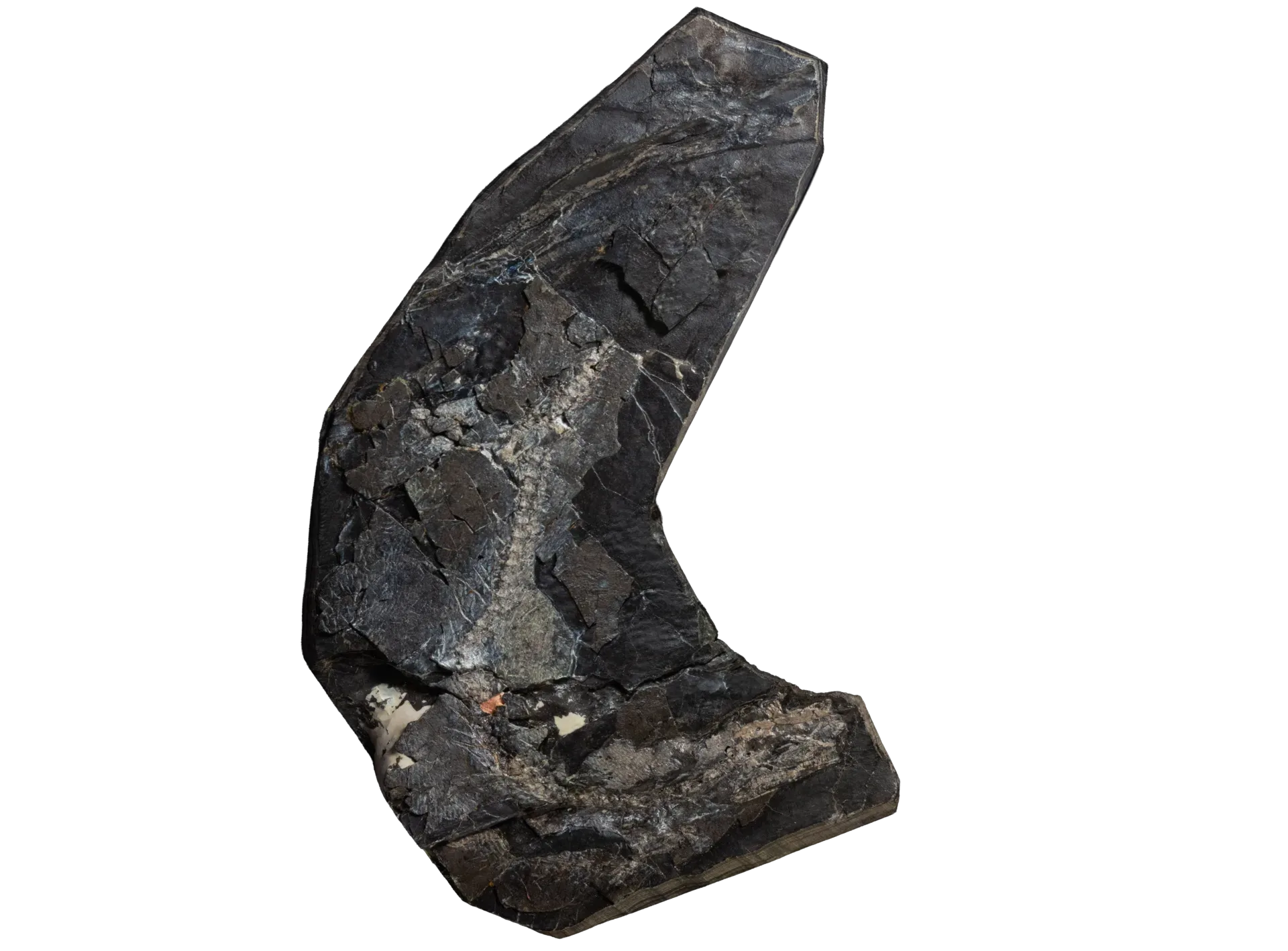
A small fossil found in Scotland, regarded for nearly three decades as one of the earliest known reptiles, has turned out to be something entirely different, after powerful X-ray scans revealed hidden gills and thousands of tiny teeth.
The 345-million-year-old animal, a species called Westlothiana lizziae, was discovered in 1984. Nicknamed "Lizzie" because it looks like a lizard, the specimen is a nearly complete skeleton preserved in two crushed slabs of rock. New research published in Nature shows it was not a reptile at all, but a primitive animal that lived in water, or in and out of it.
An icon of evolution
Early descriptions of the fossil relied on features visible on its surface, including four limbs with fingers and toes that appeared to have claw-like tips. Those features set it apart from many animals of its time, whose limbs were more like fins.
After it was described in 1990, Westlothiana was widely regarded as the earliest known amniote adapted to life on land. Amniotes are the major group of animals with backbones that includes reptiles, birds and mammals, so Lizzie became an important reference point for scientists studying when and how they first evolved.
"Lizzie has been an icon for the early evolution of amniotes for decades," said Xavier Jenkins, a postdoctoral fellow at the American Museum of Natural History and co-lead author of the study. "But when we were finally able to see inside the fossil, we found an animal that looked very different from what we expected."
Gills and a fish-like mouth
The study was led by scientists at the American Museum of Natural History and the University of Oxford, with the European Synchrotron Radiation Facility in Grenoble, France. Using its X-ray imaging, the team looked beneath the surface of the rock and reconstructed parts of the animal no one had been able to see before.
They found a primitive skull, internal gills containing bone, and a mouth like a fish's, with thousands of tiny teeth. Together, those features rule out its place on the evolutionary line leading to reptiles.
"It turns out looks can be deceiving, and Lizzie lived a completely different lifestyle than we previously thought," said Ben Igielman, co-lead author, who started the research during his graduate work at Oxford.
Claws came before life on land
The discovery changes the story of how land-living features evolved. Scientists now think claws, and the pattern of five fingers and toes familiar in reptiles and mammals, had already appeared in earlier animals that were still closely tied to water.
"This is a big surprise," said co-author Roger Benson, the museum's Macaulay Curator of Paleontology. "It shows that, although we think of amphibians as being more 'primitive' than reptiles today, some of the traits of reptiles were already there in the ancestor of both amphibians and reptiles."
Rethinking ancient footprints
The finding could also change how fossil footprints are read. Some trackways with apparently clawed digits, dated to more than 359 million years ago, have been used as evidence that amniotes had already appeared. If animals like Westlothiana also had claws, those footprints may have been left by older, amphibious creatures instead.
British institutions played their part: contributors included researchers from the University of Cambridge and the Natural History Museum in London, and the work was part-funded by UK research councils.
More in Science
All


Latest news
Featured posts
-
Things to do
Top 10 places to visit in Birmingham
-
Food and drink
The 12 most popular food spots in Birmingham
-
Things to do
The best laser tag locations in Birmingham