

First close-ups of asteroid hit by NASA reveal a stadium-sized crater
Europe's Hera spacecraft shows Dimorphos flattened on one side, tumbling wildly and circled by hundreds of boulders, four years after the DART impact.
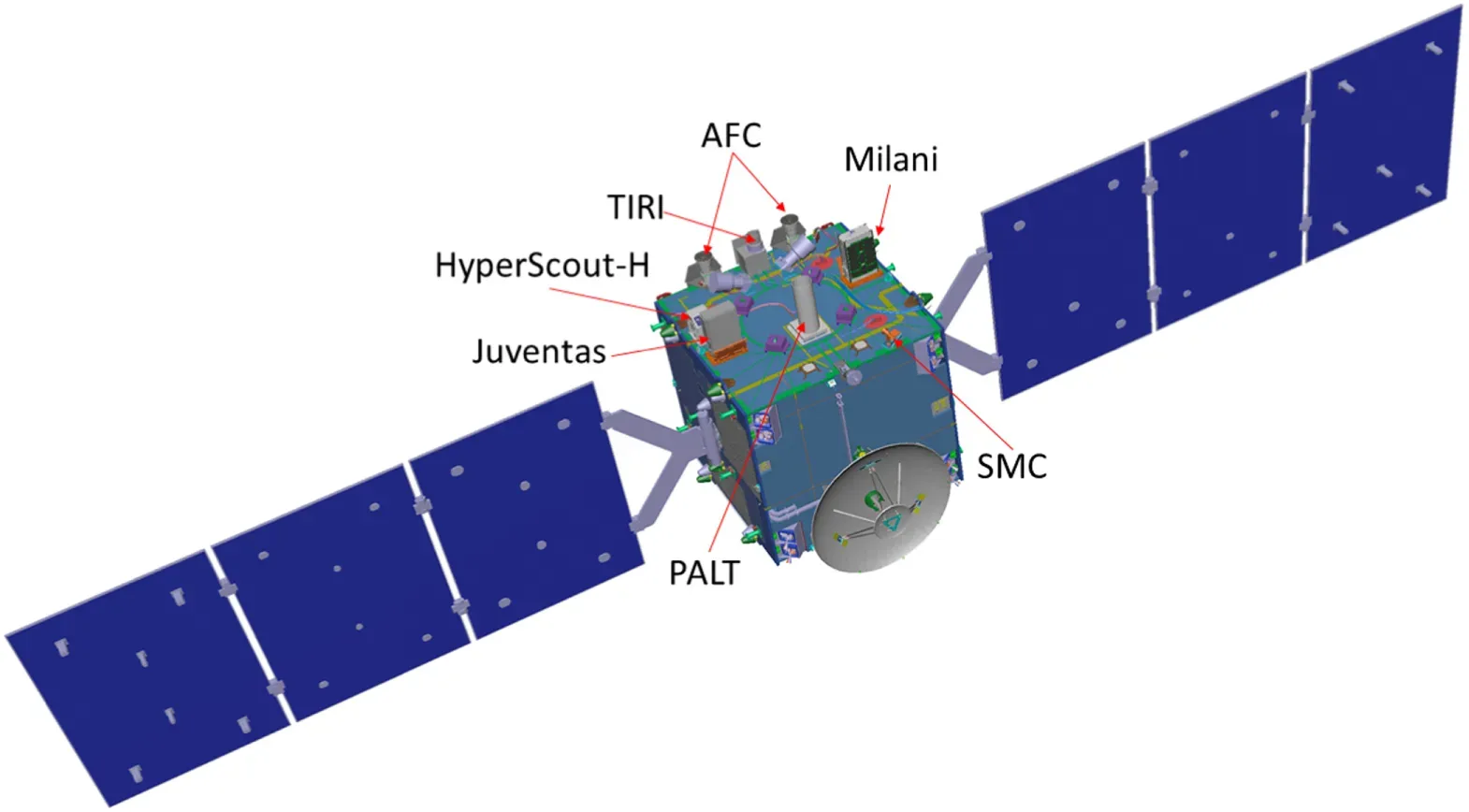
Four years after NASA deliberately crashed a spacecraft into an asteroid to knock it off course, the first close-up pictures of the aftermath show a stadium-sized crater, an asteroid tumbling chaotically and hundreds of newly discovered boulders.
The images were taken by the European Space Agency's Hera spacecraft, which reached the asteroid pair Didymos and Dimorphos this month, and they could help scientists design better missions to protect Earth from dangerous space rocks in future.
A test for planetary defence
On 26 September 2022, NASA's half-tonne Double Asteroid Redirection Test (DART) spacecraft hit Dimorphos, a roughly 160-metre-wide asteroid orbiting its larger companion Didymos, at more than 13,000mph. Neither posed any threat to Earth, but they gave scientists an ideal way to test whether knocking an asteroid off course could work.
It did. Telescopes on Earth showed the impact shortened the time Dimorphos takes to orbit Didymos by about 33 minutes. Before the collision, NASA had said a change of 73 seconds or more would count as a success.
"All three at once"
What remained unknown was what had happened to the asteroid itself. Hera, a car-sized spacecraft launched in October 2024, is surveying the pair from 25 to 30km away.
"Scientists debated whether Dimorphos had sustained an impact crater, changed its shape or stayed the same," said Dr Patrick Michel, Hera's principal investigator. "Much to our surprise the answer turns out to be all three at once. The face struck by Dart has been flattened into an impact crater the size of a sports stadium, which extends across the asteroid's entire width."
The rest of Dimorphos appears relatively unchanged, but the impact has left it "tumbling wildly in its orbit", said Dr Michael Kueppers, ESA's Hera mission scientist. "Another big surprise is that Hera is showing that the asteroids are surrounded by hundreds of orbiting boulders, just a few metres in size."
"A decisive step"
"NASA's Dart mission demonstrated that we can change an asteroid's orbit. Hera is now revealing what happened to the asteroid itself," said Hera mission manager Ian Carnelli. "By combining these two missions, humanity is taking a decisive step towards making asteroid deflection a reliable tool for protecting our planet."
Dr Michaël Marsset of the European Southern Observatory called the images "a major milestone for both planetary defence and asteroid science". Unlike natural collisions, scientists know exactly the mass, speed and path of the spacecraft that hit Dimorphos, and now have pictures from before and after.
The UK is a member of the European Space Agency, which runs the Hera mission.
More in Science
All

Latest news
Featured posts
-
Things to do
Top 10 places to visit in Birmingham
-
Food and drink
The 12 most popular food spots in Birmingham
-
Things to do
The best laser tag locations in Birmingham