
Hera spacecraft sees its two target asteroids separately for the first time
ESA's planetary defence mission has resolved Didymos and its moon Dimorphos, with detailed images due on 25 November.
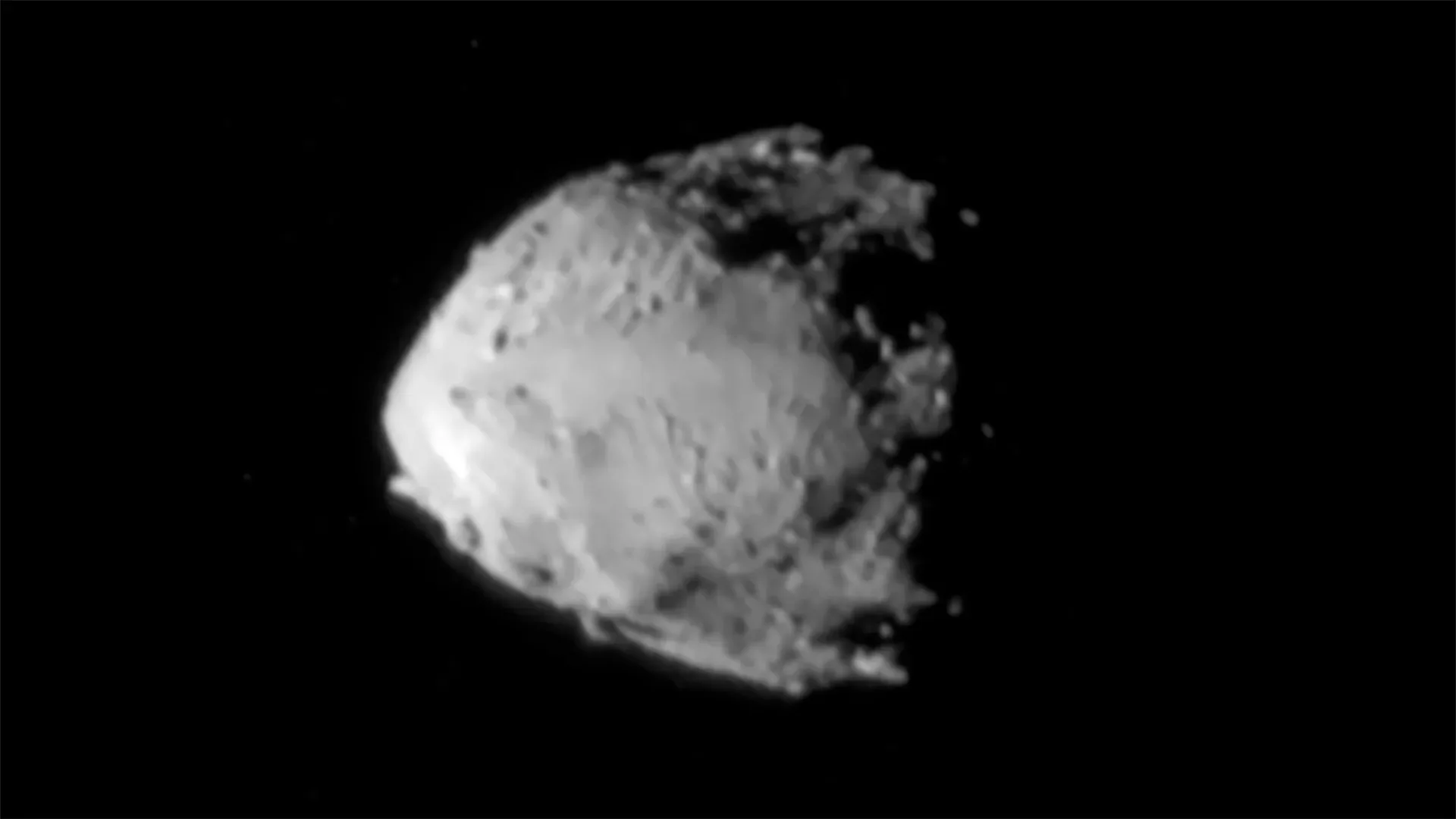
The European Space Agency's Hera spacecraft has seen its two target asteroids as separate objects for the first time, a milestone for Europe's first planetary defence mission as it closes in on the pair.
Hera imaged the asteroid Didymos and its small moon, Dimorphos, with its Asteroid Framing Camera on the evening of 18 October, from 1,280km away. The Didymos system is currently some 197 million km from Earth.
One pixel, but clearly separate
"With this image the smaller Dimorphos asteroid becomes visible for the first time," explains Michael Kueppers. "Before this acquisition the spacecraft was still resolving the Didymos system as a single dot. But now, even though Dimorphos is made up of only around one pixel in this initial image, it is clearly well separated from its parent body."
The image follows two successful braking manoeuvres earlier this month. A pair of thruster firings a week apart slowed the spacecraft to just 20 metres a second relative to the asteroids, so it can approach gradually and carefully.
The size of the targets
Dimorphos is 151 metres across, about the size of the Great Pyramid of Giza. Didymos, at 780 metres in diameter, is a little smaller than the Burj Khalifa in Dubai, the world's tallest building. The two orbit an average of 1.15km apart, with Dimorphos circling its parent at about 18cm a second.
"For the very first time we are seeing through Hera's own eyes the very double asteroid system that the mission was designed and built for," says mission manager Ian Carnelli.
"Our views will much grow sharper as Hera comes closer. We will unveil the first detailed images of Dimorphos - the first object in the Solar System to have had its orbit measurably shifted by human action - on 25 November."
A crash site investigation
In September 2022, NASA's DART spacecraft deliberately crashed into Dimorphos at 6.1km a second. The collision threw out a plume of debris across 10,000km of space and slowed the asteroid's orbit by around 33 minutes, showing for the first time that a spacecraft could nudge an asteroid off course.
Important questions remain before this "kinetic impact" method can be relied on to protect Earth. Did the impact leave a crater, or reshape the asteroid entirely? What is Dimorphos made of, how is it structured and how heavy is it? And why was the deflection so much bigger than simulations predicted?
Over the coming months, Hera will carry out a close-up survey of the impact site using several instruments, and will release two shoebox-sized CubeSats for an even closer look, eventually progressing to landing.
What comes next
The first detailed pictures of Dimorphos are due on 25 November. What Hera finds will help scientists work out whether a spacecraft could be used to turn a dangerous asteroid away from Earth in future.
More in Science
All
Latest news
Featured posts
-
Things to do
Top 10 places to visit in Birmingham
-
Food and drink
The 12 most popular food spots in Birmingham
-
Things to do
The best laser tag locations in Birmingham