
Birmingham astronomer helps find 'sunscreen' clouds on a lava planet
Webb observations suggest the molten world TOI-561 b reflects three-quarters of its starlight, which theory said it should not.
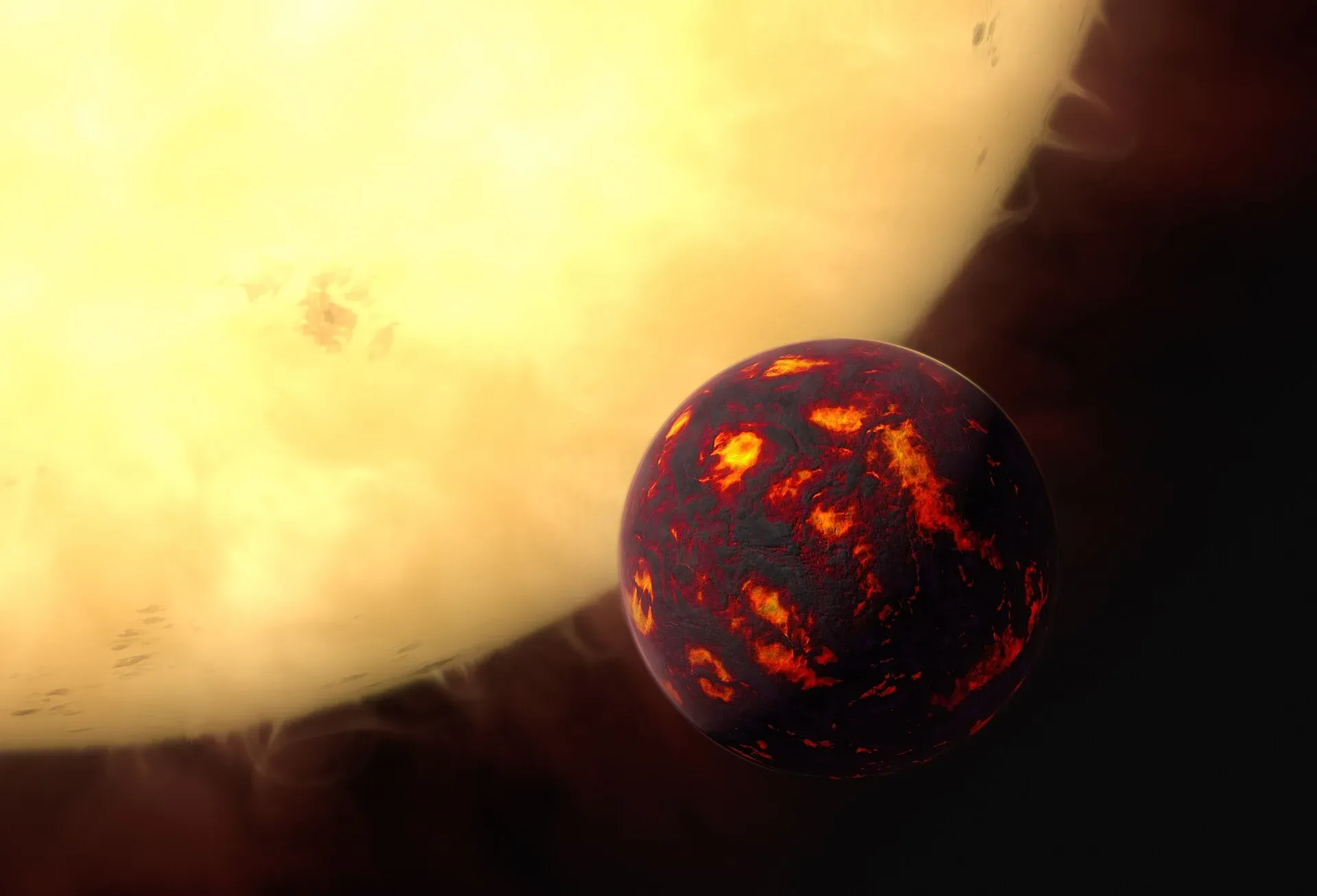
A rocky planet so close to its star that its surface is an ocean of molten rock appears to be wrapped in reflective clouds that act like a planet-wide sunscreen, according to new research involving a University of Birmingham astronomer.
The planet, TOI-561 b, lies about 280 light years from Earth. Astronomers had thought a world this hot and this heavily blasted by its star would long ago have lost any atmosphere. Instead, observations with the James Webb Space Telescope suggest it still has a substantial one, though not one anything could live in.
A surprisingly cool, bright world
The international team, including Dr Anjali Piette, assistant professor in astronomy at the University of Birmingham, watched the planet for 37 hours as it completed a full orbit of its star.
Earlier observations had shown that the planet's dayside was far cooler than expected for a bare, dark rock so close to a star. That missing heat could either be carried round to the night side, or reflected away into space before the planet absorbed it.
By watching the full orbit, the team got its first look at the night side, which always faces away from the star, and found it was not warm enough to explain the difference. Instead, TOI-561 b must reflect roughly three-quarters of the starlight that hits it, similar to Venus.
Computer simulations of the planet's climate suggest the brightness could come from clouds made of silicate minerals, including silicon dioxide and magnesium silicate, forming on the dayside and acting like sunscreen.
"Our discovery challenges current theories"
Dr Piette said: "Our discovery challenges current theories. We would expect a heavily irradiated rocky planet like TOI-561 b to have lost its atmosphere billions of years ago."
"Instead, the evidence suggests it still has a significant atmosphere today. This raises major questions such as whether the planet started with an unusually large supply of gases or if the ocean of molten rock covering its surface acts as a planet-wide volcano that is constantly feeding its atmosphere."
What the atmosphere is made of remains an open question. It could be a dense blanket of carbon dioxide, like a much hotter version of Venus, or it could be rich in sulphur dioxide, the gas released by volcanoes on Jupiter's moon Io.
The next question
Professor Lisa Dang, the project lead at the University of Waterloo in Canada, said the team measured how the planet's brightness and heat changed through its orbit, a technique called a phase curve. "The next big question we will seek to answer is whether TOI-561 b's atmosphere resembles Venus or an extreme version of Io," she said.
The findings, published in The Astronomical Journal, build on earlier work by the same researchers suggesting the planet has a thick atmosphere fed by gases released from its molten interior. It puts a Birmingham astronomer at the heart of one of Webb's most intriguing planetary puzzles.
More in Science
All

Latest news
Featured posts
-
Things to do
Top 10 places to visit in Birmingham
-
Food and drink
The 12 most popular food spots in Birmingham
-
Things to do
The best laser tag locations in Birmingham