
Hubble and Webb spot a ghostly 'cat' in the Carina Nebula
The Cat's Head Nebula, a pillar of gas and dust sculpted by starlight, is helping astronomers study how stars are born.
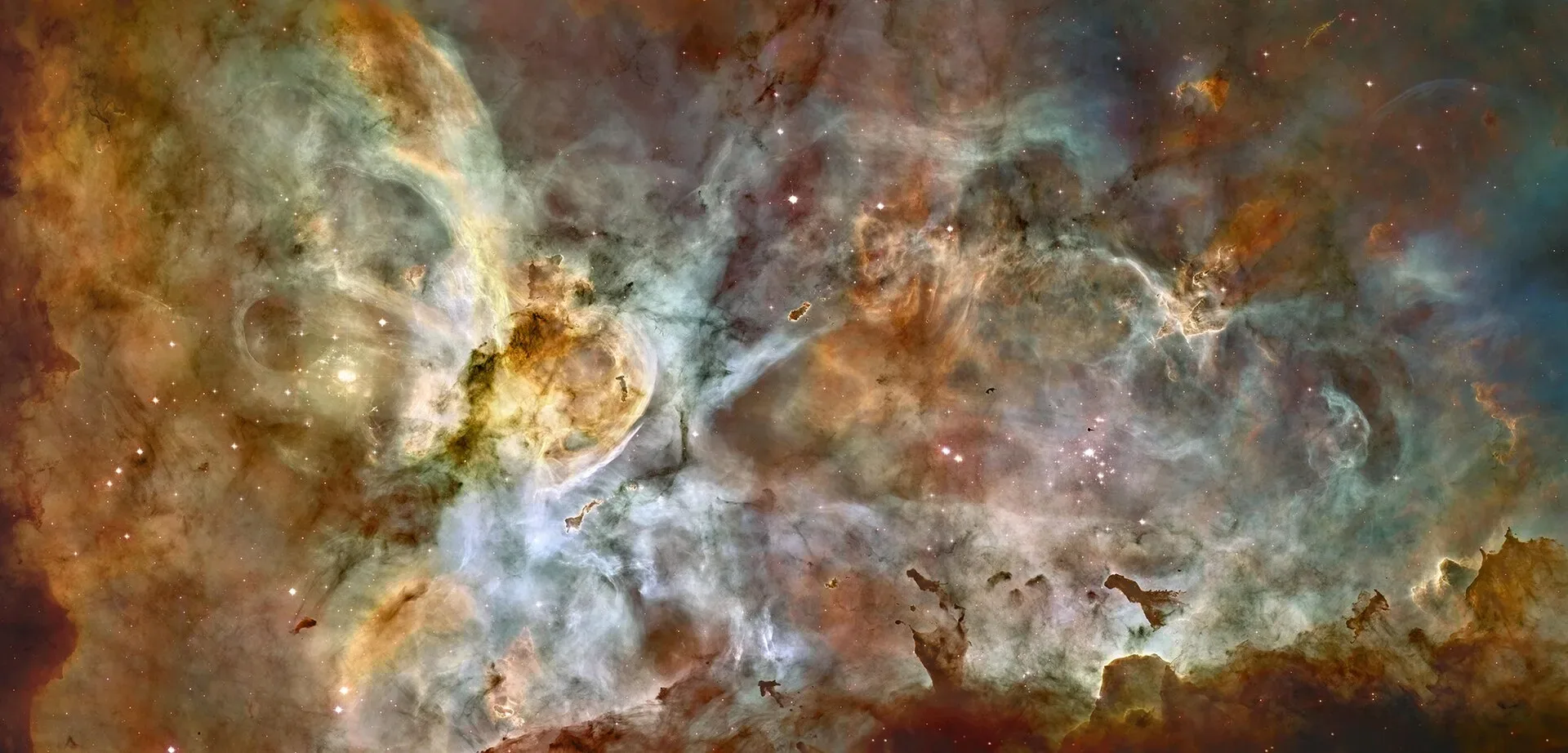
Just in time for Halloween, the Hubble and James Webb space telescopes have captured a ghostly shape lurking in the Carina Nebula: a pillar of gas and dust that looks like a cat sitting with its back to the viewer, one glowing eye turned towards us.
The European Space Agency has released images of the feature, nicknamed the Cat's Head Nebula, taken by both telescopes. Together they are helping astronomers understand how stars are born.
A cat sculpted by starlight
The Carina Nebula is a vast cloud of gas and dust where new stars are forming. The Cat's Head is a small, select part of it. Its distinctive shape has probably been sculpted over time by intense ultraviolet radiation and winds from the nebula's massive stars. As this "stellar feedback" erodes the surrounding gas and dust, the denser material inside the cat-shaped pillar resists, at least for now.
What Hubble sees
In Hubble's visible-light view, the nebula appears as an opaque, dark brown pillar of dust. The cat's glowing red eye may mark a young star still partly buried in the dust.
A hazy yellow ridge runs along the right-hand edge of the pillar. ESA says this bright rim is consistent with gas being heated and ionised by ultraviolet light from nearby massive stars, which is essentially evaporating it. The surrounding gas glows blue and cyan at the top, shifting to yellow, orange and red towards the bottom, colours that reveal a mix of glowing gas, dust and starlight.
What Webb adds
Webb sees in infrared light, which can pass through dust. In its near-infrared image the pillar becomes more transparent, its complex surface comes into view, and a dense scattering of blue and yellow stars appears. The cat's eye is still clearly visible, and a faint jet near the cat's "belly" hints that another young star is nearby, perhaps inside the cat or just to its right.
In mid-infrared light, Webb picks out warm dust and carbon-based molecules called polycyclic aromatic hydrocarbons, which glow when excited by starlight, outlining delicate globules and strands beside the pillar.
A fleeting scene
The Cat's Head will not last forever. ESA describes it as "a temporary scene that will eventually disperse", but one that is "packed with information". By combining the two telescopes' views, astronomers can learn more about the "elusive, chaotic, and complex process known as star formation".
Europe's part
Hubble is a joint project between ESA and NASA. Webb, the largest and most powerful telescope ever launched into space, is a partnership between NASA, ESA and the Canadian Space Agency. ESA provided its Ariane 5 launch and the NIRSpec spectrograph, as well as half of the MIRI mid-infrared instrument, built by a consortium of European institutes that includes UK scientists.
For anyone stepping outside on a clear night this Halloween weekend, it is a reminder that the most spectacular spooky shapes are a long way above our heads.
More in Science
All
Latest news
Featured posts
-
Things to do
Top 10 places to visit in Birmingham
-
Food and drink
The 12 most popular food spots in Birmingham
-
Things to do
The best laser tag locations in Birmingham