

Export bar placed on earliest known bird's-eye painting of a British country estate
The 1662 view of Llannerch Park in Wales, showing a lost Italian-style garden, could be saved for the nation if a buyer can match its £550,000 price.
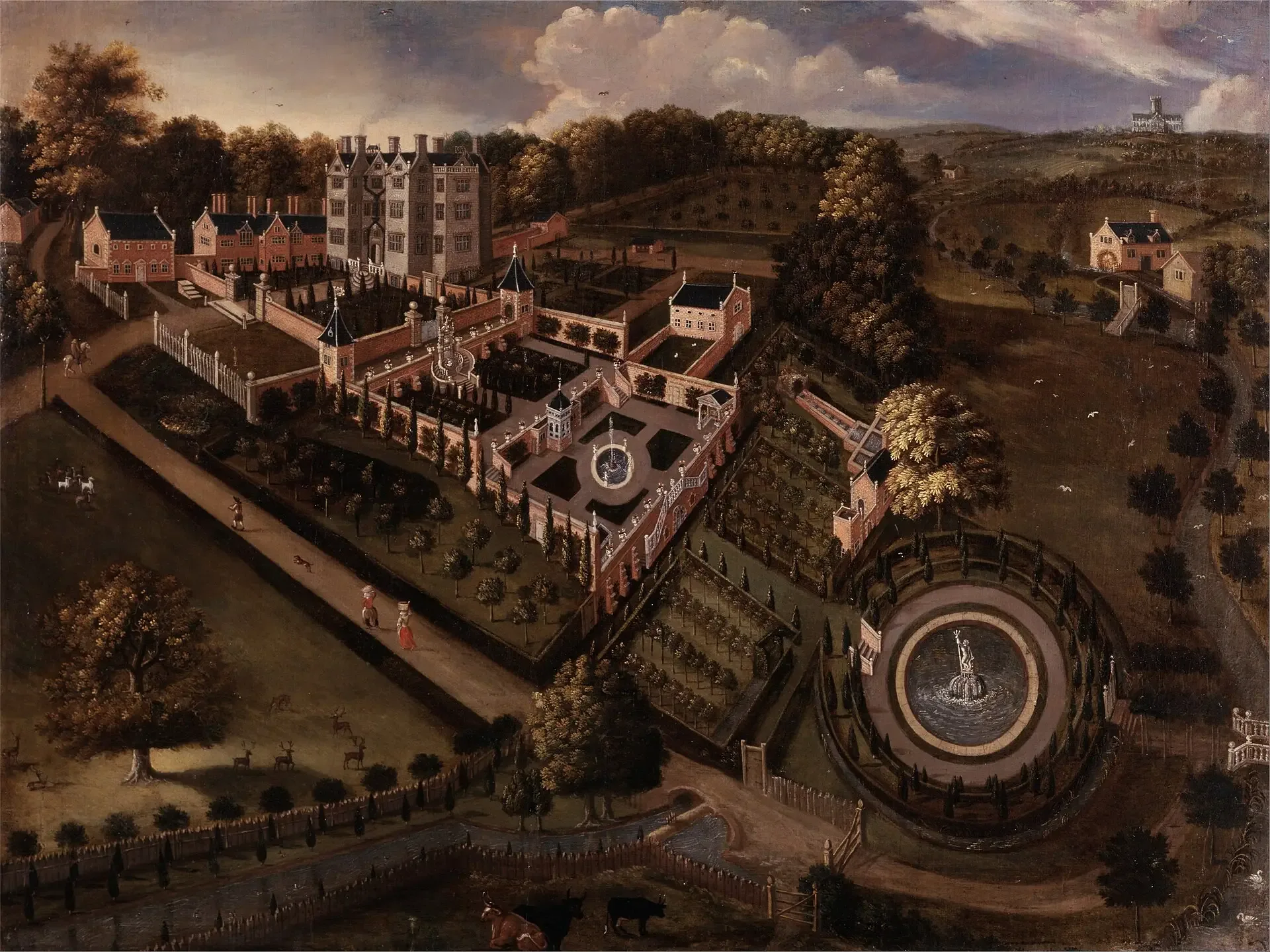
The government has temporarily blocked the export of a 1662 painting believed to be the earliest bird's-eye view of a British country estate, giving UK galleries and museums the chance to raise £550,000 to keep it in the country.
The large oil painting shows the house and Italian-style gardens at Llannerch Park in Denbighshire, north Wales, a garden that has since been lost entirely, the Department for Culture, Media and Sport announced on Friday 20 November.
A garden ahead of its time
The garden was created by the estate's owner, Mutton Davies (1633-1684), after a tour of France and Italy, a journey that would later become known as the Grand Tour. It was one of the earliest gardens of its kind in the UK, created decades before Hampton Court's famous Baroque garden.
Pippa Shirley, a member of the independent committee that advises on the export of works of art, said the painting was "the only surviving evidence of a radical Welsh garden".
"Created by a Royalist landowner following visits to France and Italy, a century before the Grand Tour became popular, it contained a series of marvellous watery innovations - pools, fountains, sculpture, cascades and hydraulic surprises all set off by Baroque architecture, staircases and planting," she said. "Nothing remotely like it had been seen in Wales before, and the fact that the garden is now entirely lost makes the painting all the more important."
Artist unknown
Painted in oil on canvas, the work measures 1.6 metres by more than 2.3 metres. The artist is unknown, but is thought to have been British, because the painting matches the English style. Bird's-eye views of country estates went on to become a popular style in Britain, and this is believed to be the earliest example.
The painting was commissioned around 1662 and passed down through the family until it was sold at Sotheby's in London in December 2014.
"An extraordinary window"
Heritage minister Baroness Twycross said: "Country houses and their remarkable gardens are iconic parts of the British landscape and irreplaceable parts of our shared national story. This painting is an extraordinary window into the development of gardens and landscape artistry in Wales and the whole of the United Kingdom."
The committee found the painting met two of the Waverley criteria, used to judge national importance: its outstanding connection with the nation's history, and its outstanding significance for the study of garden history and landscape design, mid-17th-century travel to Europe, and artistic activity around Chester at the time.
How the export bar works
The decision on the export licence has been deferred until 19 February 2027, giving time for a gallery, museum or private buyer willing to donate it to the nation to come forward at the recommended price of £550,000 plus VAT of £11,000. If a serious offer is made, a second four-month deferral would follow.
If it stays, researchers will be able to study how people and ideas moved between Wales, England and the Continent in the 17th century, and how the art of painting country estates developed in Britain.
More in Arts and Culture
All
Latest news
Featured posts
-
Things to do
Top 10 places to visit in Birmingham
-
Food and drink
The 12 most popular food spots in Birmingham
-
Things to do
The best laser tag locations in Birmingham