

Birmingham physicists help find one of nature's rarest particle decays at CERN
The LHCb result, a once-in-ten-billion decay, ends a 42-year search and gives physicists a sharper test of the rules of matter.
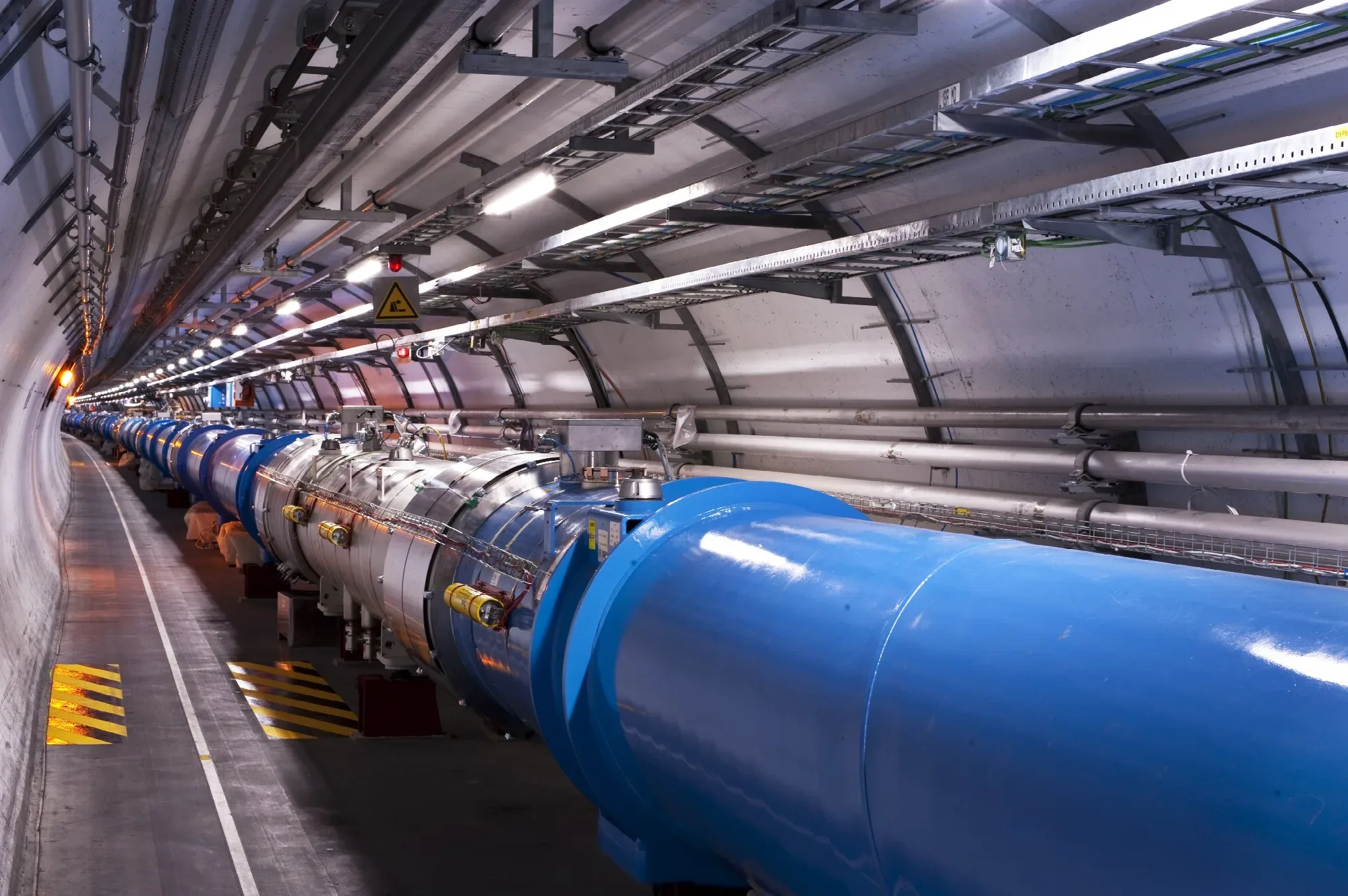
Physicists from the University of Birmingham have helped find the first evidence of one of the rarest particle decays ever seen at CERN's Large Hadron Collider, a milestone in a search that has lasted 42 years.
The result, announced by the Science and Technology Facilities Council (STFC), which funded the research, comes from the LHCb experiment near Geneva, where Birmingham researchers play leading roles in building the detector and collecting its data.
Once in ten billion
LHCb studies particles that contain a "beauty quark", one of the fundamental building blocks of matter and a heavier relative of the quarks that make up most of the visible universe. These beauty particles are produced in large numbers when protons collide at the LHC, but they survive for only around one and a half trillionths of a second before decaying into lighter particles.
The new measurement provides evidence for an exceptionally rare decay, in which a neutral beauty particle, a B meson, turns into two muons, heavier cousins of the electron. According to the Standard Model, the theory physicists use as their rulebook for particles and forces, this should happen only once in every ten billion such particles. It is the rarest decay of its kind yet observed at the LHC.
Testing the rulebook
The measurements agree with the Standard Model's predictions, but they push the tests to new levels of precision and into territory that had not been explored before. Physicists hope that future studies of these rare decays could reveal hints of new particles or forces hiding in what researchers call the "Zeptoverse", a realm of extraordinarily small distances.
Dr Niladri Sahoo, Research Fellow at the University of Birmingham and convener of the LHCb Very Rare Decays working group, said: "Reporting the first evidence from a single experiment for the extremely rare decay of a neutral B meson into two muons, while achieving the world's most precise measurements of the corresponding Bs-meson decay probability and lifetime, provides a powerful new test of the Standard Model and a window into potential new physics."
Dr Dan Johnson, Assistant Professor at the University of Birmingham and Physics Coordinator for the LHCb-UK teams, said: "UK leadership has been critical to this remarkable feat, from the data analysis to construction of the ultra-precise silicon detectors upon which it relied."
Five times the data
The discovery was made possible by the upgraded LHCb detector, which since 2024 has been collecting data at up to five times its previous rate. Scientists combined new data from 2024 and 2025 with data gathered between 2011 and 2018, and used machine learning and advanced particle-identification methods to pick out the rare signal from billions of collisions.
Professor Nigel Watson, former principal investigator for the LHCb-UK teams, said: "This stunning new result is the latest of many exciting measurements at LHCb that are only possible through the exceptional commitment and talent of a large international collaboration of scientists and engineers, who designed, built and now operate the experiment and analyse the data. It is a privilege that our group in Birmingham has key roles in this scientific adventure of discovery."
A UK team effort
Alongside Birmingham, the UK institutions involved include the universities of Bristol, Cambridge, Edinburgh, Glasgow, Liverpool, Manchester, Oxford and Warwick, Imperial College London and STFC's Rutherford Appleton Laboratory.
As the upgraded experiment keeps collecting data, the researchers plan to explore this tiny world in even more detail, in search of answers to some of the biggest questions in physics, including whether there are particles and forces beyond those we already know.
More in Science
All
Latest news
Featured posts
-
Things to do
Top 10 places to visit in Birmingham
-
Food and drink
The 12 most popular food spots in Birmingham
-
Things to do
The best laser tag locations in Birmingham