

Voyager 1 to become first spacecraft a light-day from Earth, and NASA wants you to flash a torch
The probe crosses the milestone on 18 November. NASA invites people to flash VGR in Morse code at the sky after sunset on 17 November.
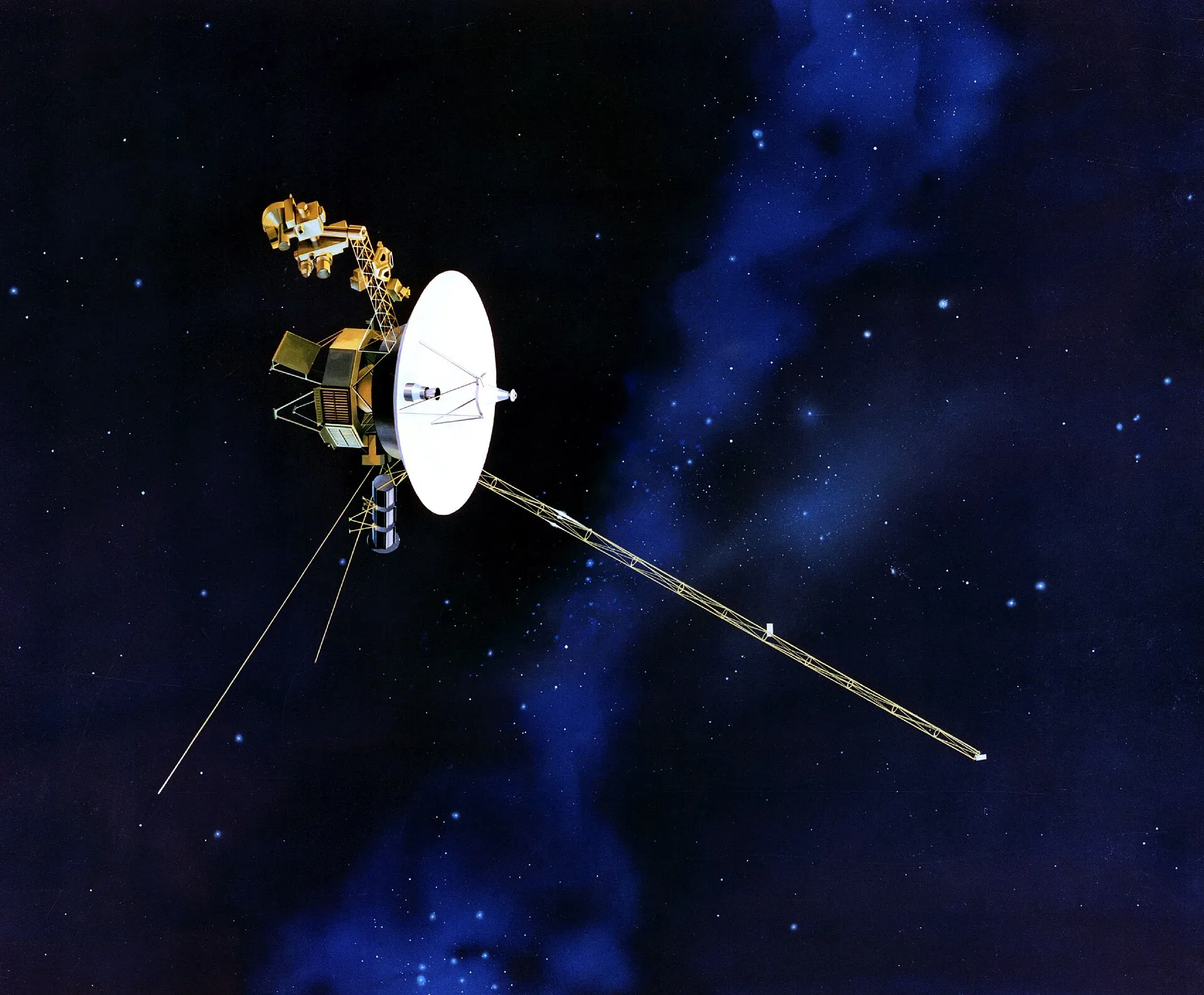
Next week, NASA's Voyager 1 will become the first human-made object to reach one light-day from Earth, so far away that its radio signals, travelling at the speed of light, take a full day to reach us. NASA is inviting people around the world to mark the moment by flashing a light at the night sky.
The spacecraft will cross the milestone at 10:16 UTC on Wednesday 18 November, The Register reported on 11 November. A light-day is about 16.1 billion miles, or 25.9 billion kilometres.
"Shine Bright for Voyager's Light-Day"
For the event, people are invited to flash the mission's three-letter code, VGR, in Morse code after sunset on Tuesday 17 November, using a torch or NASA's website. NASA says this will create "a symbolic wave of golden light encircling the planet after sunset".
Voyager 1 will not, of course, be able to see it. Its cameras were switched off decades ago, after it took the famous Pale Blue Dot image of Earth. But it is a fitting way to celebrate a machine that has kept working far beyond anything its builders imagined.
VGR in Morse code is dot-dot-dot-dash, dash-dash-dot, dot-dash-dot: short-short-short-long, long-long-short, short-long-short.
Nearly 50 years in space
Voyager 1 is travelling at around 38,000mph and is already the most distant human-made object from Earth. It will mark the 50th anniversary of its launch next year. It suffered a communications hiccup last month, but continues to send back data from interstellar space, the region beyond the bubble of the Sun's influence.
Its twin, Voyager 2, took a different path through the solar system to fly past Uranus and Neptune, and is not expected to reach a light-day from Earth for another nine years. With its power supply dwindling, it is uncertain whether it will still be able to communicate by then.
The Register noted that NASA has invited the public to join in like this before: in 2013, the Cassini spacecraft photographed Earth from Saturn on "The Day the Earth Smiled", while people were encouraged to look up and wave.
How to take part from Birmingham
After sunset on Tuesday 17 November, which in Birmingham is a little after 4pm, step outside with a torch, point it at the sky and flash VGR. The best views of the stars will be away from street lights, in places such as the Lickey Hills, Sutton Park or a back garden, though the signal is symbolic, so anywhere will do.
Voyager 1 lies far beyond the planets, in the direction of the constellation Ophiuchus, and is far too faint to see with any telescope. But for families looking for a reason to look up together on a November evening, saying hello to the most distant machine humans have ever built is a pretty good one.
More in Science
All
Latest news
-
12 Nov
Rugby friends, 12, named Fundraiser of the Year for 250-mile London to Paris charity bike ride
-
12 Nov
Birmingham museums offer 15% off gifts for Museum Shop Sunday, including a new Joe Lycett range
-
12 Nov
Kenya discharges its last Ebola patient and could be declared free of the disease on 23 December
Featured posts
-
Things to do
Top 10 places to visit in Birmingham
-
Food and drink
The 12 most popular food spots in Birmingham
-
Things to do
The best laser tag locations in Birmingham