

Aston University's School of Optometry celebrates 100 years of training eye specialists
What began as optics classes for 25 students in 1926 has educated more than 6,000 optometrists and become a leading centre for research into childhood myopia.
Aston University's School of Optometry has marked 100 years of training eye care professionals in Birmingham, celebrating a century that began with 25 students in a technical school classroom and has produced more than 6,000 optics and optometry graduates.
Staff, students, alumni and guests gathered at the university's Vision Sciences building for a day of celebrations, Aston University announced on Thursday 19 November.
From 25 students to thousands
In 1926, Birmingham Technical School, one of the institutions that went on to form Aston University, began offering classes in what was then called optics, to around 25 students. The first cohort included a chemist, a toolmaker, a spectacle maker and an apprentice optician. Only one was a woman.
Today the school welcomes around 150 undergraduates a year, along with more than 100 postgraduate taught students studying for qualifications including professional certificates in medical retina, glaucoma and paediatrics, as well as doctoral researchers.
A century of firsts
The school has a long record of pioneering work. It offered its first course in contact lenses in 1947, and in 1963 set up a Clinical Neurophysiology Unit that became an international centre for understanding seizures triggered by visual stimulation. In the 1970s it introduced NHS hospital placements for students, transforming what had been very theoretical courses, and in 1974 it began research into childhood myopia, an area in which it remains a leading centre.
More recently its researchers have shown that changes in the blood vessels of the retina can reveal early signs of heart and circulation problems. Since 2022 the school has used virtual reality to train future eye care specialists in its Ophthalmic Simulation suite, and its academics are now investigating how AI could change eye care information, clinical decisions and teaching.
Heritage on show
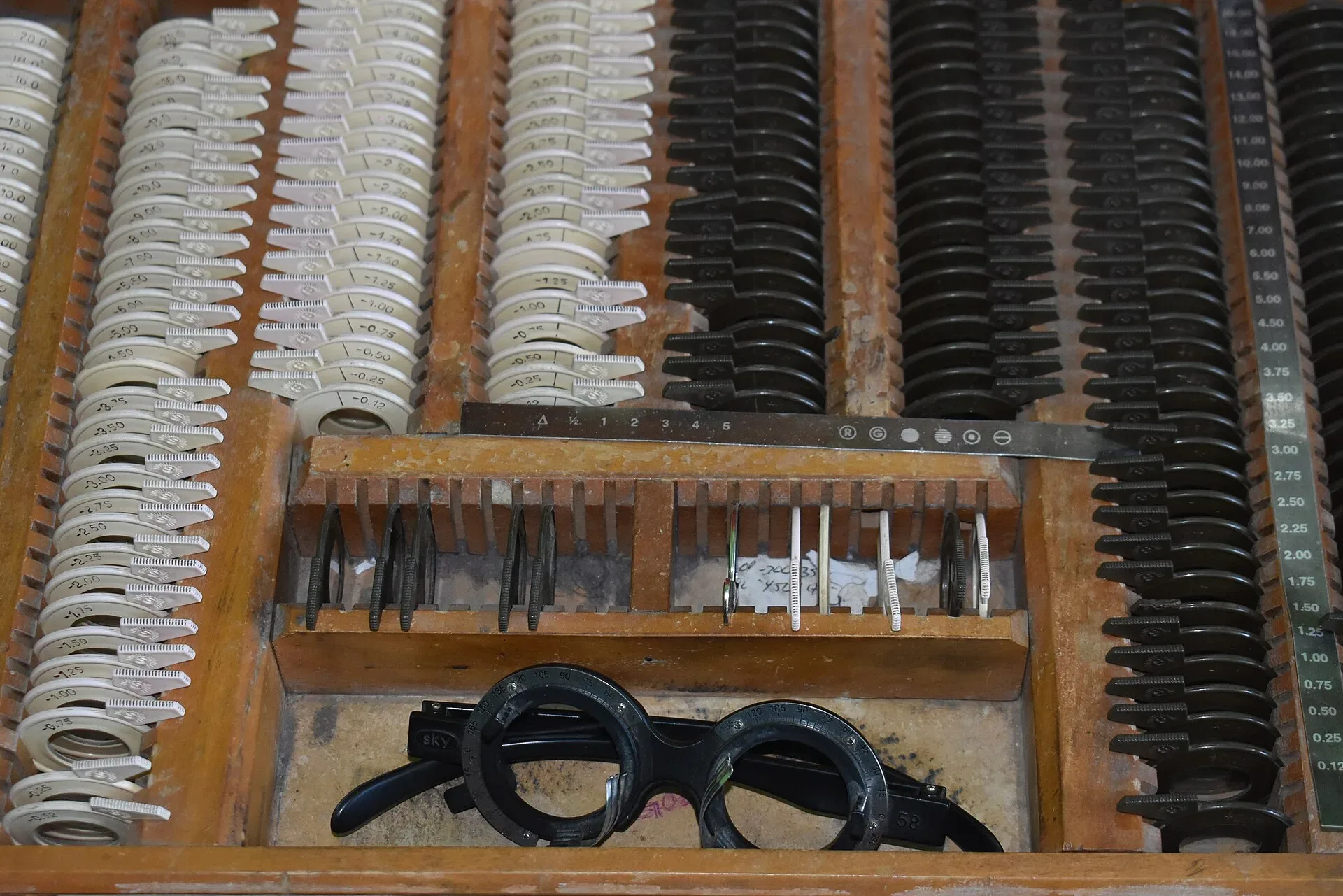
To mark the anniversary, the Aston University Archive put on a heritage exhibition of old optometry equipment, historical eye charts, photographs and handwritten registration books from 1926. Dr Amy Sheppard, head of optometry, showed the vice-chancellor, Professor Colin Grant, around the building and the exhibition.
The Vision Sciences building itself was opened in 1987 by the then Prince of Wales, now King Charles III. Alumni toured the campus to revisit old haunts, and there were professional development workshops on dry eye assessment and orthoptic techniques.
"An extraordinary milestone"
The keynote lecture, on the evolution of cataract surgery, was given by Jesse Panthagani, a consultant ophthalmologist at North West Anglia NHS Foundation Trust, who was taught by Aston colleagues as he prepared for his professional exams.
"Reaching 100 years is an extraordinary milestone for Aston's School of Optometry. It reflects not only a proud history of education, research and clinical excellence, but also the generations of optometrists who have helped shape the profession," he said.
"Modern cataract care is very much a multidisciplinary effort, with optometrists playing an increasingly important role in both preoperative assessment and postoperative care."
For a city that has long trained the professionals behind its hospitals, high streets and clinics, a century of Aston optometrists is something to celebrate.
More in Education
All

Latest news
Featured posts
-
Things to do
Top 10 places to visit in Birmingham
-
Food and drink
The 12 most popular food spots in Birmingham
-
Things to do
The best laser tag locations in Birmingham